Mind Maps and Image Boards for Developing Creative Ideas
Use a mind map or image board to develop a creative idea: choose the right starting tool, connect words and visuals, and find a useful next direction.
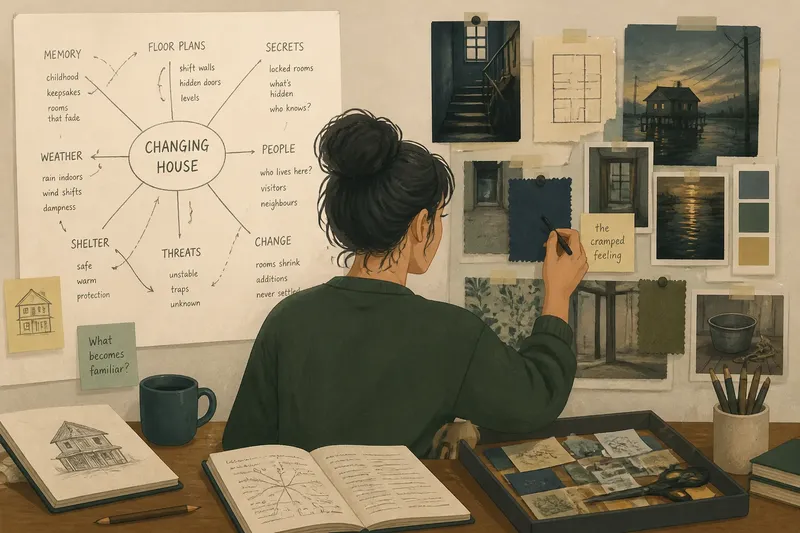
A scrap of an idea sits beside your notebook: a house that keeps changing its rooms. A mind map or image board can help you develop that idea, but each makes a different kind of connection easier to spot.
A mind map lays out associations in words; an image board lets you compare references at a glance. The choice is less about which tool is best and more about what your idea currently lacks: relationships between thoughts, or a visual language you can recognise.
Mind maps for ideas
Put a phrase, image or subject in the centre of a page, then draw branches for associations. The changing house might lead to “memory”, “floor plans”, “secrets” and “weather”; smaller branches can add details such as “rooms shrink” or “rain indoors”.
This format is useful when you can describe the subject but have not yet worked out its tensions. Branches can hold competing possibilities without forcing a choice: the house might offer shelter and feel threatening at the same time. Use pencil, a whiteboard or a notes app, and add arrows where separate thoughts begin to affect one another.
Words are less useful when the difficulty is how something looks or feels. A page full of explanations may clarify the premise while leaving its colours, surfaces and spatial rhythm untouched. In that case, a visual collection can do more useful work.
Image boards for atmosphere
An image board places references together so their differences and echoes become visible. For the changing house, it might combine a narrow stairwell, a paper pattern, a window sketch and a note about dusk light. Their arrangement can suggest a mood that no single reference carries alone.
Make a physical board with cut-outs, or use a digital canvas that allows images to move freely. Include photographs, fabric, colour, architecture, gestures or objects when they help you think. A short caption such as “the cramped feeling” records what you noticed without telling you to copy the exact room.
Keep the source of borrowed images with the board if you may share or publish it. References can also become a collection of attractive but unrelated material. If everything has the same tone, compare items that pull in opposite directions; the contrast may reveal a more distinctive atmosphere.
Choose a starting tool
Start with a mind map if the idea is tangled in motives, themes or possible events. Start with an image board if you can name the intended feeling but cannot yet picture its shape, palette, setting or texture. Switching from one to the other is useful when the first format keeps circling the same material.
Say you are planning a small theatre piece set in a flooded village. Your starting notes say only “water, neighbours, change”, and you cannot tell what the piece is about. Write those words in the centre of a mind map, then add branches for “who stays”, “what is carried” and “what becomes familiar”; the resulting choice may be to follow the neighbour who keeps repairing a doorway. If the story is already clear but the stage world remains vague, gather references for reflected light, damp wood and salvaged objects instead. The observable result is a set of visual choices to explore, not a finished design.
Moving between formats need not be elaborate. Circle a lively phrase on a mind map and find images that complicate it, or choose an unexpected pairing on a board and write down why it catches your attention. The change can expose an assumption that the first format made easy to miss.
Questions about the tools?
Can I use both methods?
Yes: let the format that exposes your current uncertainty come first. A phrase from a map can guide an image board, while a striking contrast between images can prompt new branches.
How many branches should a mind map have?
There is no required number; stop when new branches repeat what is already on the page. If that happens, add a more specific prompt or try a different format rather than expanding the same route.
What belongs on an image board?
Choose references that help you notice a quality, such as a colour, material, gesture, layout or kind of light. A useful item may be awkward or contrasting rather than beautiful.
How can I use references without copying them?
Write down the quality that caught your eye, such as an enclosed space or a jagged outline, instead of treating the source as a template. Then translate that quality into another context or combine it with different references.
Keep the working material
Do not tidy away the alternatives as soon as one idea appeals. Mark a phrase or image with a star, and leave nearby possibilities visible; later, their contrast may help you understand why the favourite works.
What is not worth the effort is making a map or board polished before it has helped you think. Matching colours, perfect lettering and elaborate templates can draw attention away from the connections you are trying to notice. A messy page that clarifies a choice is doing its job.
For developing a creative idea, choose the format that lets you notice a relationship you could not see before. If neither one helps, change the material: move from words to images, or from images back to a few precise phrases. That shift can give you a more revealing next decision than polishing the same page.