The Polished-Too-Soon Draft: Why Early Editing Can Narrow an Idea
The polished-too-soon draft can steer an idea into a narrow shape. Learn to spot premature edits, choose what to keep, and revise with purpose.
You reread a paragraph about a chipped blue mug, replace “bright” with “glossy”, then adjust the opening until it sounds finished. Yet the detail that made you write—the mug appearing whenever you avoid a difficult phone call—has not entered the draft. A polished-too-soon draft can make a small observation look like the whole subject.
The answer is not to keep every sentence rough. It is to decide what kind of edit the work needs: a note that lets you continue, a structural change that alters the piece, or a line edit that makes settled meaning clearer. Those jobs are easier to distinguish when you can name the decision in front of you.
Three editing jobs
Clarifying edits make the draft usable: add a temporary heading, identify a missing detail, or replace an illegible handwritten word with a marker. Structural edits test what belongs and in what order. Line edits refine wording, rhythm and punctuation.
The categories can overlap, but they ask different questions. “What happens next?” calls for material; “Does this scene belong?” calls for structural judgement; “Is this verb precise?” calls for line editing. Treating all three as polishing can send you to the sentence before you know whether the paragraph has a job.
Why polish can mislead
A smoothly written opening can begin to dictate what the rest of the piece must be. If a more compelling connection appears later, you may feel pressure to bend it back towards that opening simply because you have already spent time shaping it.
Polish also makes effort visible. A carefully tuned description may feel more valuable than a plain sentence that carries the central thought. But the work invested in a passage does not decide whether it serves the draft.
Sentence-level attention has its own pull: while searching for a sharper adjective, you can miss a change in the subject or a recurring detail that deserves space. The useful question is not “Does this sound good?” but “What is this passage doing here?”
Edits worth delaying
Some choices depend on seeing the piece as a whole. The opening, ending, section order, transitions, repeated ideas and final sentence rhythm are hard to judge while the central thought is still shifting. Mark a possible issue, then return to it once you can compare the draft’s directions.
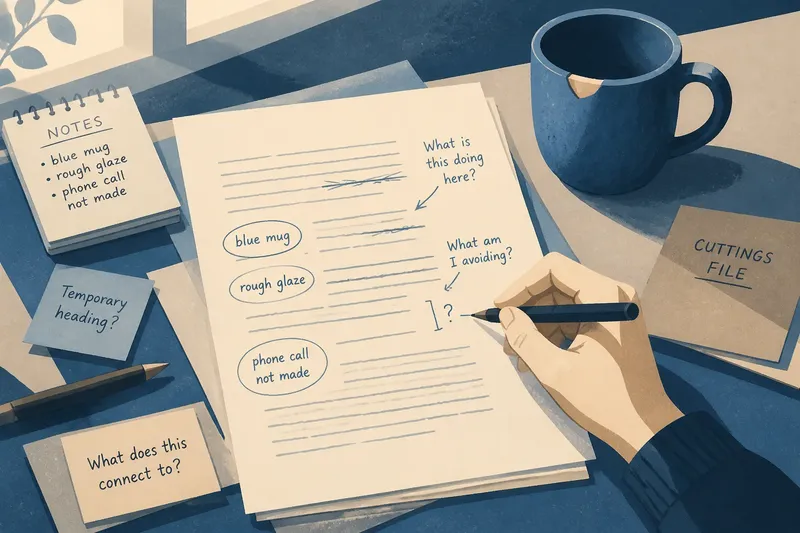
Do not delete a passage just because it feels digressive. Add a margin note such as “What does this connect to?” or move it to a temporary cuttings file. That preserves a choice for later without pretending every fragment belongs in the finished piece.
By contrast, fix anything that blocks your next move. If a note is unreadable, clarify it; if you keep losing your place, add headings; if a missing fact matters to the next paragraph, insert a bracketed reminder. These edits support the work in front of you rather than decorate it.
A worked mug example
Imagine you have three rough notes for a short personal essay: a chipped blue mug on the kitchen shelf, its uneven glaze, and the fact that you notice it before making a difficult phone call. You first intended to describe the mug’s colour, but the repeated moment suggests a possible link between the object and your hesitation.
Write the starting material down as it is: “blue mug”, “rough glaze”, “phone call not made”. Add a temporary note beside the third item: “What am I avoiding?” Then draft a paragraph that connects the mug to the pause before the call, without yet deciding whether the piece is about the object, the hesitation or both.
On rereading, suppose the paragraph makes the hesitation clearer while the glaze description adds no new meaning. The resulting decision is to keep the mug as the scene’s anchor, shorten the surface description, and explore the hesitation in the next section. That is a workable direction, not proof that the essay has one inevitable subject.
What should you ask first?
How do I know whether to line-edit?
Try to state the passage’s purpose in plain language before adjusting its sound. If you cannot yet say what it contributes, mark the uncertainty and consider structure or content first.
Should I correct every typo as I draft?
Correct an error if it makes the meaning hard to recover or keeps interrupting your attention. Otherwise, leave a visible marker and keep writing; a dedicated proofread is better suited to small surface fixes.
What should I do with a passage I may cut?
Copy it to a cuttings file or use version history, then remove it from the working draft if it interrupts the current line of thought. If the draft later needs its context or image, you can retrieve it without forcing it to stay in place now.
Useful revision checks
- Check whether you can name the passage’s purpose; if you can, keep or move it according to that purpose, and if you cannot, add a question in the margin before deciding.
- Check whether a sentence is unclear enough to stop you continuing; if it is, rewrite it in plain language, and if it is not, mark it for a later line edit.
- Check whether the opening still matches the subject that emerges later; if it does, retain it for now, and if it does not, note a possible new opening rather than polishing the old one.
- Check whether a repeated image develops the idea or merely repeats it; if it develops the idea, keep the strongest instances, and if it merely repeats, mark the extras for a structural pass.
- Check whether a suspected digression contains a question or detail that returns elsewhere; if it does, test where it belongs, and if it does not, move it to cuttings rather than deleting it outright.
- Check whether your next session has a clear starting point; if it does, save the draft as it stands, and if it does not, leave a brief note naming the next question to explore.
It is not worth building an elaborate filing system for every discarded phrase unless maintaining one genuinely helps you work. A clearly named cuttings document or ordinary version history is usually enough to make a considered edit feel less final.
When to revise closely
Begin a substantial revision when you have enough material to compare possible directions: perhaps an ending has changed the meaning of the opening, a detail has recurred, or separate fragments now speak to one another. You do not need to exhaust every thought; you need a draft whose choices you can inspect.
Save a copy before major cuts, then work from large decisions towards small ones. Ask what the piece is about now, choose which material supports that, arrange the sections, and only then refine sentences and punctuation. If the central idea shifts, the structure can shift before you invest more time in lines that may leave.
For a polished-too-soon draft, the most useful next edit may be a question beside the paragraph that feels finished: what does it help the reader understand? A clear answer earns the paragraph its place; an uncertain one points towards the next revision, not an automatic verdict.