From Sketchbook Margins to a Place for Thinking
Use a sketchbook as a place for creative thinking: capture useful observations, connect them through simple experiments, and return to ideas with clearer context.
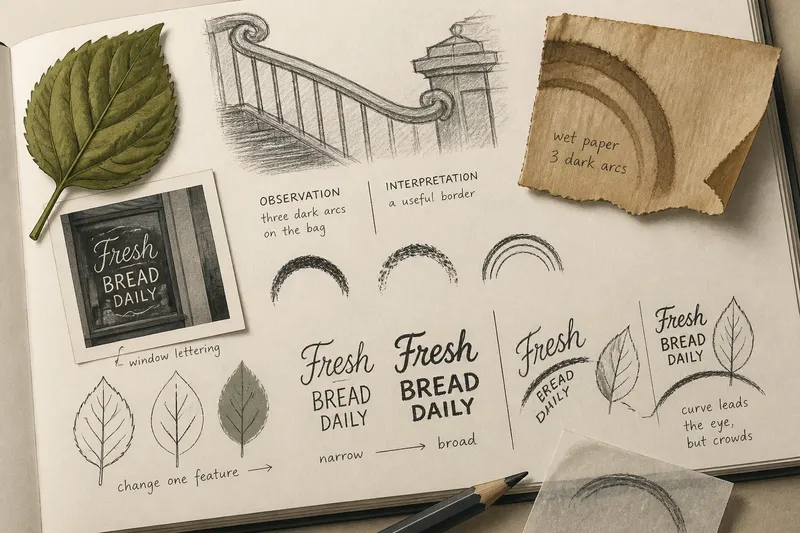
A torn paper label curls beside a sketch of a stair rail; underneath, three versions of its shadow crowd the page. A sketchbook as a place for creative thinking can hold such scraps of attention, preserving what caught your eye and how you responded. It need not become a gallery of finished work.
Imagine you are collecting material for a small creative project, but have not yet decided what it should become. On the walk home, you notice the blunt shape of a leaf, hand-lettered words in a shop window and a dark ring left by damp soil on a paper bag. A sketchbook lets these unrelated details sit together while you explore what each one might suggest.
Start with observation
Separate what you saw from what you think it means. “Three dark arcs on the bag” describes an observation; “a useful border” is an interpretation. Keep both if you like, but putting them in different places makes it easier to return to the original detail when your first idea no longer feels interesting.
Use whatever lets you record the thought without fuss: a pencil, soft graphite, a fine-liner, a glue stick for scraps or a printed phone photograph with a note beside it. In a digital notebook, keep the image close to your response. Colour-coded tabs and elaborate indexing are not worth the effort if maintaining them interrupts the act of noticing.
Try small variations
Put an observation beside a few quick experiments. Draw the soil ring as a loose curve, reduce the leaf to a handful of veins, or copy the shop lettering with wider strokes. Each mark asks a small question: what changes if the shape is simplified, repeated or made to lead the eye?
Add a brief note about what you notice. “The curve feels heavy” gives you something to respond to; “bad” does not. If the letters feel lively but crowd a nearby sketch, record that tension rather than erasing the attempt. The point is to preserve a useful clue about what the mark does.
Change one feature at a time when you want to understand its effect. Outline the leaf in one version and fill it in the next; make a letter narrow, then broad. These comparisons help you notice which qualities hold your attention, without requiring a polished result or a verdict about which version is best.
Connect distant details
Later, the shop lettering might bring the bag’s uneven arcs to mind. Draw the letters along a curve and place the leaf nearby; then note what feels different from the separate trials. The connection grows from having kept the original marks visible, not from needing to invent a grand explanation for them.
Say you return to the page and find that a curved line draws your eye more than a straight one, while leaving little room for other marks. You could sketch a more open curve and compare the space it leaves, or keep the line straight and use the arcs as a small motif elsewhere. In either case, the visible result tells you whether the shapes feel connected or compete for attention.
Leave some room around a drawing if you expect to revisit it. A strip of empty paper can take a tracing-paper overlay, a scrap or a later note. Filling every margin with commentary may make a page look busy while making its visual relationships harder to see.
Keep a readable trail
Use plain-language cues to help you return to a thought: “window lettering”, “wet paper” or “curved shapes”. A date can add context, and a paper tab can mark a page worth revisiting, but neither needs to become an elaborate filing system.
When you come back, add a fresh mark in a different pencil or ink rather than quietly replacing the old one. The contrast can show what changed: a shape made simpler, an interpretation set aside or a new question beside an earlier note. A few words are usually enough to recall why you were curious.
Some pages will hold only a phrase or a quick rubbing from a textured surface; others may collect several trials and a pasted scrap. That unevenness is part of the record. A sketchbook earns its place through the particular clues it keeps, not through making every spread equally full.
Questions about sketchbooks?
What should I put in a sketchbook?
Include observations, fragments, trials and brief notes that help you think. A ticket, leaf outline or phrase can sit beside a drawing when it gives that mark useful context.
Do sketchbook drawings need to look good?
No; they need to make your thought visible. A rough comparison of shapes can show more about what you are considering than a polished drawing that hides its alternatives.
How do I find an old idea again?
Add a plain cue about the subject or material, such as “window lettering”. When you revisit it, leave the original mark in place and add a new response nearby so the difference is easy to see.
Is paper or a digital notebook better?
Choose the format that makes it easy to keep an observation beside your response to it. Paper welcomes quick drawing and physical scraps; a digital notebook can keep photographs and searchable notes together.
A small worked example
Imagine you have a leaf outline, a photograph of the shop lettering and a note describing three arcs on a paper bag. First, copy the leaf in a few quick forms and mark the arcs beside them. Next, draw the lettering along a curved line, then compare it with a straight version. If the curved mark makes the page feel crowded, widen the curve or move the arcs to the margin; if the separate shapes feel unrelated, repeat one small curve beside the leaf. The resulting page shows which arrangement holds together visually, while keeping the source details available for another attempt.
A sketchbook as a place for creative thinking is most useful when it keeps a detail close to the thought it sparked. When an ordinary walk leaves you with a mark you cannot yet explain, note what you saw beside it; that small bit of context can make the page worth returning to.